HopisPharma

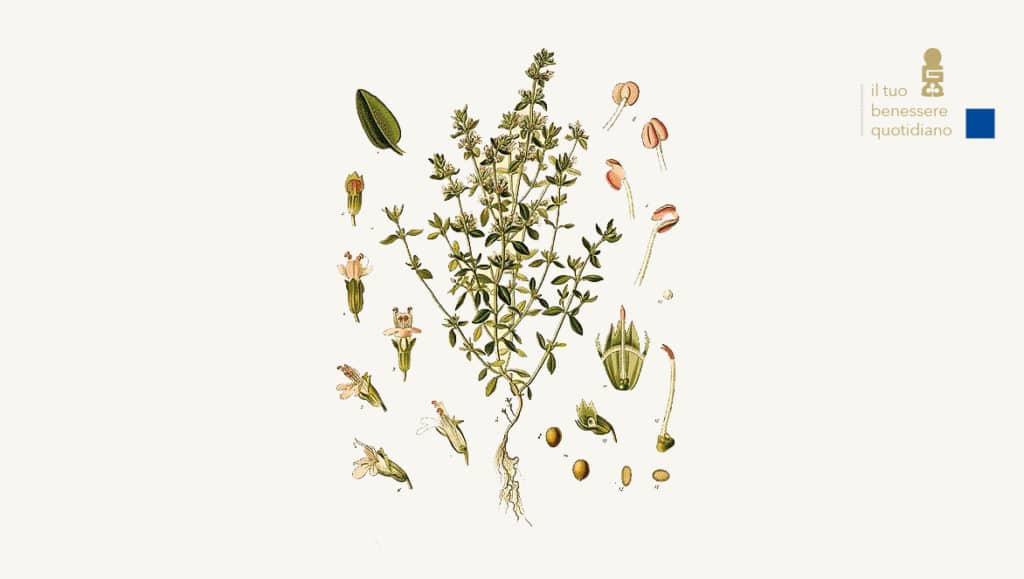
Tymus vulgaris L.

The thyme plant is an evergreen shrub native to southeastern Europe and the Mediterranean, varying in height depending on the species from a few centimeters to more than thirty, with a stem that becomes woody after the second year of life. For example, thyme (Thymus vulgaris L.) has seven different chemotypes (i.e., with "stably" different composition), six of which are located mainly in southern France and one in Spain. Harvesting, generally takes place from late June to mid-August, when half of the flowers are open. Particular care must be taken to respect the basal buds, which ensure regrowth and thus subsequent production. So when talking about thyme essential oil, it will not be enough to indicate the botanical name of the plant species, but one must also know what chemotype it represents and thus the marker that characterize it.
Distillation, that process used to extract OE essential oils, was first introduced in the East (Egypt, India and Persia) more than 2,000 years ago and then improved by the Arabs in 900 AD . The main constituents responsible for the many virtues of precious thyme essential oil are mostly phenols, particularly thymol(23% -60%), terpinene (18% -50%), p-cymene (8% -44%), carvacrol (2% -8%) and linalool (3% -4%). The bacteriostatic and bactericidal antioxidant activity of thyme essential oil was used for infected skin lesions and excoriations, including war wounds, as early as the latter half of the 1800s. Thyme was and is used as an antiseptic, antimicrobial, astringent, anthelmintic, carminative and tonic. Thyme is useful in cases of intestinal infections as well as Candida albicans. One of its constituents, thymol, is active against enterobacteria, may improve liver function and act as an appetite stimulant. Long used in bronchial and urinary infections.


 BIBLIOGRAPHY

Cornaghi L, Arnaboldi F, Calo R, Landoni F, Baruffaldi Preis WF, Marabini L, et al. Cells, tissues, organs. 2016;201[3]:180-92.

El-Nekeety AA, Mohamed SR, Hathout AS, Hassan NS, Aly SE, et al. (2011) Antioxidant properties of Thymus vulgaris oil against aflatoxin-induced oxidative stress in male rats. Toxicon 57: 984-991.

Amiri H (2012) Essential oils composition and antioxidant properties of three Thymus species. Evid Based Complement Alternat Med 2012: 728065.

 Bauer K., D. Garbe and H. Surburg 2001. Common Fragrance and Flavor Materials: Preparation, Properties and Uses. Wiley-VCH publisher, 293.

Srva, 2004 - Plantes medicinales et aromatiques. Service romande de vulgarisation agricole, Lausanne - Switzerland.

Kokkini S., 1997. Taxonomy, diversity and distribution of Origanum species. Oregano. Proceedings of the IPGRI International Workshop on Oregano, 8-12 may 1996, Valenzano (Bari), Italy. 2-12, Padulosi S. editor..

Guenther E. 1948. The Essential Oils. D. Van Nostrand editor

Duke, J.A. Handbook of Phytochemical Constituents of GRAS Herbs and Other Economic Plants.; CRC Press: Boca Raton, FL, USA, 1992.

Cornara, L.; La Rocca, A.; Marsili, S.; Mariotti, M.G. Traditional uses of plants in the eastern Riviera (Liguria, Italy). J. Ethnopharmacol. 2000, 125, 16-30.

Superior Institute of Health Essential oils for human health and environmental protection. Edited by Francesca Mondello, Anna Maria Marella, Maria Grazia Bellardi, and Maura Di Vito 2015, ii, 85 p. ISTISAN Reports 15/6

Related Products

  • Welltuss®

    Syrups

    Welltuss®

    15.00
Hopispharma sas

Via della Previdenza Sociale, 3
42124 Reggio Emilia

P. IVA: 02499330351
Registro imprese CCIAA di Reggio Emilia - RE- 28701

Newsletter

Sign up for our newsletter to receive updates on products and promotions.

By submitting this form I acknowledge that I have reviewed the Privacy Policy